This may be a lengthy post, possibly a little controversial, and I may upset the apple cart with a few of you. If at any point, you feel you have a difference of opinion, please feel free to skip this post. I’ve always been open with you as my readers from the start, and I’m not stopping now. This is also a safe space for everyone.
I’ve thought a lot about what Chloe will be like in the future because of her narcissistic father. In recent years, I’ve also witnessed a boy growing up to be a man under the control of his manipulative mother. And a close friend of mine, who frequently reads my posts, has experienced what many parents would consider a worst-case scenario. Her child has grown up and chosen to side with the narcissistic parent, alienating his own mother in the process.
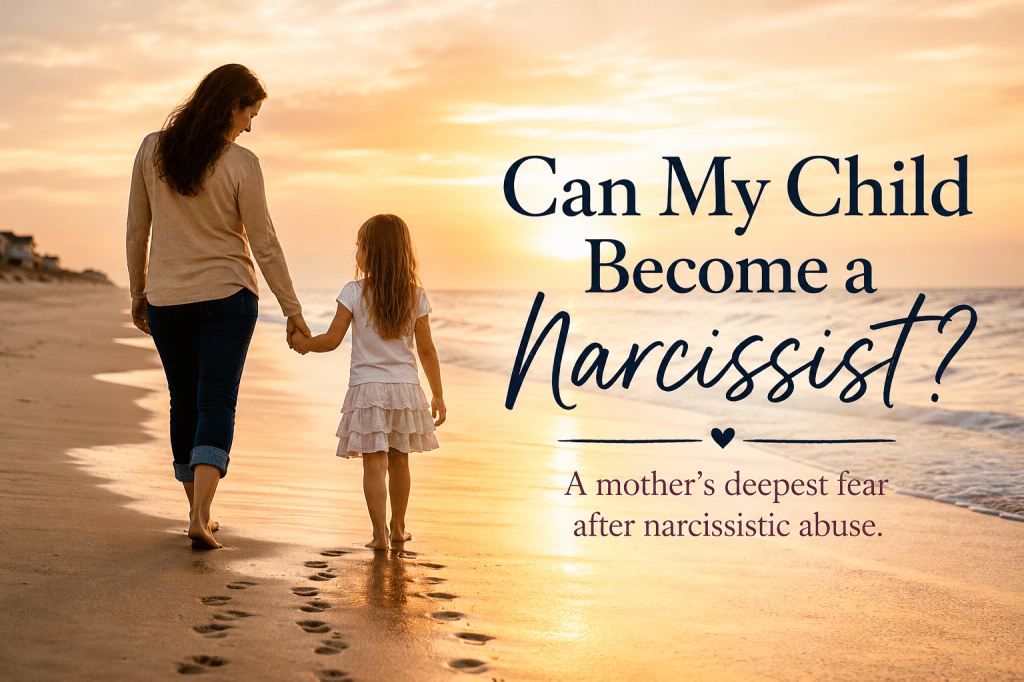
The questions arise: “Will my child grow up to be like their narcissistic parent?” and “Why has my child chosen this path?”
My friend asked me this specific question the other day about her son, and I just stared at my phone. In all of the writings I have done, and everything I have shared with all of you, the one thing I’ve tried very hard not to focus on is fear.
The truth is, I am terrified that Chloe will end up like Sly.
As survivors, we spend so much time worrying about court dates, co-parenting struggles, gaslighting, manipulation, parental alienation, and simply trying to keep our own sanity intact that we rarely talk about one of the biggest fears lurking beneath the surface. What if, despite all of our efforts, our children become like the person who hurt us? What if all the lessons we’re teaching are outweighed by the influence of the narcissistic parent? What if one day we wake up and realize we’ve lost them?
When I read my friend’s message, my heart sank. She is living through something that I think many of us secretly fear. She loves her son. She always loved her son. She sacrificed for him, protected him, advocated for him, and did everything she could to give him a better life. Yet here she is, watching him stand beside the very person who caused so much destruction.
I couldn’t stop thinking about it.
So over the last several days, I started researching.
Not because I wanted reassurance. Not because I wanted someone to tell me everything would be okay. I wanted answers.
How does someone become a narcissist?
The first thing I discovered is that there really isn’t one simple answer.
Honestly, I was hoping there would be.
I wanted to find an article that pointed to one thing and said, “This is it. This is why narcissists become narcissists.” Unfortunately, the deeper I dug, the more complicated the answer became.
The research suggests that narcissism develops through a combination of factors. Genetics appear to play a role. Childhood experiences appear to play a role. Parenting styles, attachment wounds, emotional neglect, trauma, overindulgence, criticism, family dynamics, and even neurological differences may all contribute. Most experts seem to agree that there isn’t a single cause. Rather, it’s a perfect storm of influences that shape a person’s emotional development over time.
Some of the research does suggest that there are primary pathways that can shape a narcissist. Childhood environment and trauma is one. Growing up in an unstable environment and facing abuse, neglect or abandonment can force a child to develop some of these narcissistic traits. Parenting extremes was also mentioned. This is the overindulgence and excessive, unearned praise that can cause any child to develop an unrealistic sense of importance. And of course with any mental health condition, genetics always plays a role.
I’m including a YouTube link here. I follow Doctor Ramani, and this is what she has to say about How a Narcissist is Created. https://www.youtube.com/watch?v=d79qPeIt1GY
One of the most interesting things I read was that narcissism is often viewed as a defense mechanism. When you strip away the arrogance, entitlement, manipulation, superiority, and lack of empathy, there is often a deeply insecure person underneath. Someone who learned very early in life that vulnerability wasn’t safe. Someone who learned that their authentic self wasn’t acceptable.
So they created a mask.
Eventually, that mask became who they were.
As I was reading all of this, I found myself thinking about the people I’ve known personally.
Of course, Sly immediately came to mind.
I’ve spent enough years around him and his family to observe certain patterns. His parents are still married. To an outsider, that might sound like stability. But being married and being emotionally healthy are two entirely different things.
His mother has always struck me as controlling, manipulative, and emotionally dominant. His father has always seemed more passive. Present, but passive. The type of person who complains about things but doesn’t necessarily step in and create change.
Then I found myself thinking about another young man I’ve watched grow up over the years. For privacy purposes, we’ll call him Aiden.
Aiden’s story is different in some ways and remarkably similar in others.
His parents divorced when he was young. His mother remained heavily involved in every aspect of his life. Extremely controlling. Extremely manipulative. The type of parent who struggles to let go. His father loves him, but structure, discipline, and boundaries have never really been his strong suit.
As I’ve watched Aiden grow into adulthood, I’ve noticed behaviors that make me uncomfortable because they remind me of things I’ve seen before. The need to always be right. Difficulty accepting responsibility. Manipulation. Entitlement. A tendency to view disagreements as personal attacks rather than opportunities for growth.
A strong dynamic that has been shown to breed narcissism is one with a controlling mother, passive or absent father figure, and a cycle of manipulation.
When a mother is overly controlling she often treats the child as an extension of herself rather than an independent person, which teaches the child that love is conditional. To survive this, the child creates a false sense of self.
The passive or absent father who fails to step in, the child essentially becomes trapped in the mother’s unhealthy emotional system. The child lacks a protective figure to intervene against the mother’s manipulation, and a healthy role model to tach emotional regulation, accountability and boundaries. The child is taught that the only way to handle a toxic person is passive compliance. When a father becomes an enabler or refuses to stand up to a manipulative spouse, the child experiences a profound sense of betrayal.
The manipulation cycle teaches the child that relationships are about control, leverage, and hidden agendas. They can later internalize these behaviors, which later manifest as the manipulation and lack of empathy. The mother micromanages the child’s life, teaching them that they cannot survive without her constant direction. Simultaneously, the mother rejects the emotional needs, treating them as an extension of her own.
This all together can create a young adult who is deeply insecure, yet fiercely entitled and demanding of special treatment to make up for the emotional deprivation that they suffered early on.
Now before anyone misunderstands what I’m saying, let me be clear.
I am not diagnosing anyone.
I am not saying every controlling mother creates a narcissist.
I am not saying every passive father causes emotional damage.
Life is much more complicated than that.
What I am saying is that when I look at the people in my life who display narcissistic traits, I keep seeing similar themes. Control. Enmeshment. Manipulation. Conditional love. Poor boundaries. Children learning that relationships are based on power instead of connection.
One concept that repeatedly came up during my research was something called enmeshment. This occurs when a parent becomes so emotionally intertwined with their child that healthy boundaries cease to exist. The child isn’t encouraged to become their own person. Instead, they are expected to meet the emotional needs of the parent, often at the expense of their own identity.
When I learned about enmeshment, several people immediately came to mind.
I started wondering what happens to a child who grows up believing their job is to manage a parent’s emotions. What happens when a child learns that love is earned through compliance? What happens when they learn that guilt, manipulation, and control are normal parts of relationships?
Eventually, those lessons become their blueprint.
That realization led me to the next question. If narcissism can be influenced by family dynamics, what are the chances that our children follow the same path?
The answer wasn’t nearly as hopeless as I expected.
Children of narcissistic parents do appear to be at greater risk of developing narcissistic traits. However, greater risk is not the same thing as certainty. In fact, many children raised by narcissists become the complete opposite. They become empathetic because they know what it feels like to be hurt. They become compassionate because they know what it feels like to be ignored. They become accountable because they spent their childhood watching someone avoid accountability. They become emotionally aware because they spent years navigating emotional chaos.
If growing up with a narcissistic parent automatically created another narcissist, many of us reading this would have become exactly like the people who abused us.
Yet we didn’t. Many of us became the cycle breakers. That realization gave me more comfort than anything else I read. Because if narcissism were purely genetic, there would be very little hope. If it were purely environmental, there would still be very little hope for those of us forced to co-parent with narcissists.
But the reality appears to be much more nuanced than that.
Children are constantly being shaped by multiple influences throughout their lives. Parents matter. Friends matter. Teachers matter. Mentors matter. Life experiences matter. Personal choices matter.
Which brings me back to my friend and the question she asked me.
Why would a child choose the narcissistic parent?
Why would a child distance themselves from the very parent who protected them, loved them, advocated for them, and sacrificed for them?
I wish I could give a simple answer, but after reading through countless articles, studies, personal accounts, and survivor stories, I’ve come to realize there usually isn’t one.
One of the things that kept appearing throughout my research was the concept of parental alienation and loyalty conflicts. Children, even adult children, are often placed in impossible situations by narcissistic parents. They are taught, either directly or indirectly, that love is conditional. They learn that acceptance is based on loyalty. They learn that disagreement comes with consequences.
For many years, I assumed that when a child chose the narcissistic parent, it was because they genuinely believed that parent was right. While that may sometimes be true, the reality appears to be much more complicated.
Children who grow up around narcissistic abuse are often conditioned to prioritize survival over authenticity. They learn to manage emotions, avoid conflict, and adapt themselves to whatever version of reality keeps them safest. Over time, that survival strategy becomes second nature.
If one parent constantly controls the narrative, rewrites history, plays the victim, and demands loyalty, the child eventually learns that disagreement comes at a cost. Sometimes that cost is emotional rejection. Sometimes it’s guilt. Sometimes it’s shame. Sometimes it’s being completely cut off.
When viewed through that lens, a child siding with a narcissistic parent doesn’t always mean they agree with them. Sometimes it means they have spent years learning that compliance is safer than resistance.
That doesn’t make it hurt any less.
As I thought about my friend’s situation, I found myself wondering whether this is one of the cruelest parts of narcissistic abuse. The abuse never ends with the relationship. It continues through the children. Sometimes it continues through years of manipulation, subtle influence, rewritten memories, and divided loyalties.
And sometimes the parent left standing on the outside is left questioning everything.
Were they not loving enough? Did they miss something? Could they have done more? Could they have prevented it?
I think those are natural questions. In fact, I think most parents would ask them.
But the more I researched, the more I kept coming back to one uncomfortable truth. Children are not robots. They are not computers that simply process our input and produce a predictable output.
Two children can grow up in the exact same household and become completely different adults. One may develop incredible empathy and self-awareness. Another may develop narcissistic traits. Another may spend years struggling before eventually finding their own path.
Human beings are far more complicated than that.
Which brings me back to Chloe.
If I’m being completely honest, this entire research rabbit hole started because a friend’s rhetorical question about her son opened up a door in my soul, and I needed to find more information. It also made that suppressed feeling of fear reemerge.
I looked at my friend’s situation. I looked at some of the dynamics I’ve personally witnessed over the years. I looked at Sly. I looked at Aiden. And then I looked at my daughter.
I think every parent who has survived narcissistic abuse has probably had that moment. The moment where they lie awake at night and wonder if they’re doing enough. The moment where they question whether love can compete with manipulation. The moment where they wonder whether years of healthy parenting can withstand the influence of one toxic person.
I don’t have all of those answers. In fact, I’m not sure anyone does.
What I do know is that fear can easily rob us of the moments we’re living right now. I can spend the next ten years worrying about who Chloe might become. Or I can spend the next ten years helping shape who she is becoming.
Those are two very different things. One is rooted in fear. The other is rooted in hope.
And if there is one thing narcissistic abuse has taught me, it’s that hope is always worth fighting for.


 Narcissistic Abuse Survival
Leave a comment