
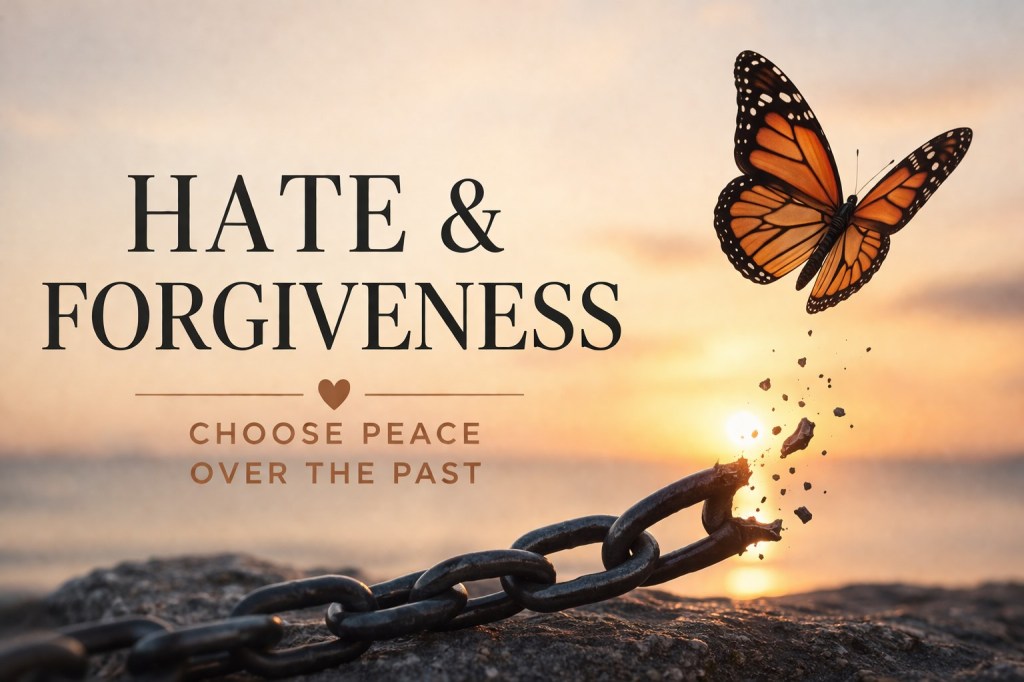
Let’s talk about hate and forgiveness.
These are two things I’ve wrestled with for most of my life—especially when it comes to Sly.
Let’s start with hate.
When I was growing up, my mother used to say that if you hated someone, it meant you wished them dead. That idea stuck with me for years. It made hate feel dark, dangerous—almost unforgivable in itself. But as I got older, I realized that hate isn’t always that extreme.
Hate, at its core, is an intense emotional response—deep dislike, aversion, or even hostility toward someone or something. It doesn’t always mean you want someone gone from this earth. Sometimes it just means you’ve been hurt so deeply that your emotions have nowhere else to go.
And when it comes to abuse… hate can feel almost inevitable.
When someone knowingly hurts you—over and over again—without remorse, without empathy, without even acknowledging your humanity… what are you supposed to feel? Love? Understanding? Compassion?
Of course not.
For many of us, especially those of us who tend to think in black and white, emotions fall into extremes: we either love, or we hate. There’s very little room in between. And when the person who hurt you was once someone you loved… that emotional shift can feel violent in itself.
So let me be honest with you—because I always am here.
Yes, I have hated Sly.
There were times when the anger consumed me. When I replayed everything in my head and felt rage bubbling up. When I wanted justice… or karma… or something—anything—that would make it all feel balanced.
That feeling is not uncommon. In fact, I think it’s something almost every survivor experiences at some point.
But here’s what I’ve learned:
Hate doesn’t just sit quietly inside you. It demands space.
It takes your energy.
It takes your focus.
It takes your peace.
There’s a quote by Johnny Depp:
“Hate is a very expensive emotion.”
And it really is.
Not just emotionally—but physically too. Living in a constant state of anger and resentment raises stress hormones like cortisol and adrenaline. Over time, that can impact your heart, your digestion, your mental health… your entire well-being.
Hate keeps you tied to the person who hurt you.
And at some point, I realized… I didn’t want to give him that kind of power anymore.
Let me be clear—that doesn’t mean I like him. It doesn’t mean I excuse anything he’s done.
It simply means I chose myself.
Now, when I think about him—or when something happens—it’s no longer that deep emotional spiral. It’s more of an eye roll. A quiet acknowledgment. A “this is exactly who he is” kind of moment.
And honestly? That’s freedom in its own way.
But there’s another layer to this for me: Chloe.
She’s still learning how to navigate the reality of narcissistic abuse. She’s still processing things that no child should have to process. And I have to be present for her. Fully present.
If I’m consumed by hate, I can’t show up the way she needs me to.
And children are always watching. They absorb more than we think. When they see one parent openly hating the other—even when it’s justified—it can create confusion, resentment, and even distance.
At the end of the day, that person is still their parent. And that’s a complicated truth we have to navigate carefully.
So then comes the next question…
If I choose not to hate him—does that mean I have to forgive him?
My answer? Absolutely not.
And I know this might be controversial.
Forgiveness is often described as this beautiful, freeing process. According to Greater Good: The Science of a Meaningful Life, forgiveness is the intentional decision to release resentment and anger toward someone who has harmed you—whether they deserve it or not.
But here’s where I struggle with that idea.
To me, forgiveness—especially in cases of long-term, intentional abuse—can feel like minimizing what happened. Like saying, “It’s okay now.”
And it wasn’t okay.
It will never be okay.
I’m someone who believes in second chances—when they’re earned. If someone makes a mistake, owns it, and genuinely changes… that’s different. That’s human.
But repeated harm?
Intentional harm?
Abuse without accountability?
That’s not something I personally believe needs to be forgiven.
And I know I’m not alone in that.
I’ve spent a lot of time listening to experts like Dr. Ramani Durvasula, who talks openly about how forgiveness is not a requirement for healing—especially when it comes to narcissistic abuse.
You are allowed to heal without forgiving.
You are allowed to move forward without giving closure to someone who never gave you respect.
For me, the goal isn’t forgiveness.
The goal is neutrality.
Peace.
Detachment.
I’ve chosen to let go of hate—not because he deserves that release, but because I deserve peace.
And I’ve also chosen not to force forgiveness—because I refuse to betray my own truth just to meet someone else’s definition of healing.
Now I want to hear from you.
What do you believe about hate and forgiveness?
Do you think letting go of hate requires forgiveness?
Have you found peace without forgiving someone who hurt you?
Or do you believe forgiveness is necessary for healing?
There’s no judgment here—only conversation.
Resources that may help you on your journey:
- Greater Good Science Center – Articles and research on forgiveness, healing, and emotional well-being
- Dr. Ramani YouTube Channel – Insight on narcissistic abuse and why forgiveness isn’t always necessary
- National Domestic Violence Hotline – 1-800-799-7233 or thehotline.org
- Psychology Today – Find therapists and read articles on trauma and recovery
 Narcissistic Abuse Survival
Leave a comment